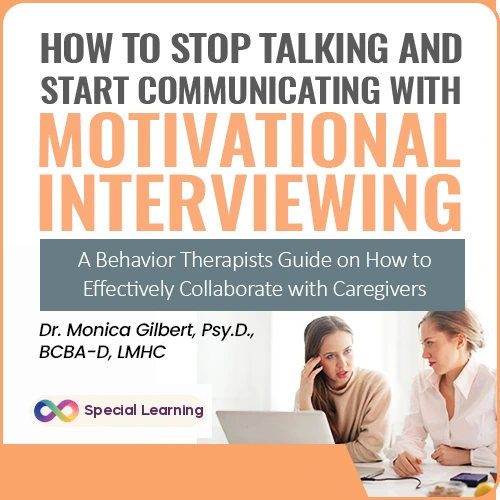
Partnering with Parents: Motivational Interviewing
You could be the first person to provide your opinion.

How can a conversation with a caregiver reveal what makes a treatment plan hard to use? In this recording, Monica Gilbert explores motivational interviewing through open questions, reflective listening and worked conversations. The session focuses on understanding a person's reasons for change and responding to ambivalence with respect for their choices.
What the session covers
- Participation and practical barriers: how confidence, family demands, expectations and available resources enter conversations about a treatment plan.
- Readiness for change: the stages discussed in the session, from not recognizing a problem through preparation, action and maintenance, including setbacks.
- Open questions and reflective listening: the OARS framework of open questions, affirmations, reflections and summaries. One worked example shows how asking what a caregiver actually does reveals a detail that a yes-or-no question misses.
- Elicit–provide–elicit: ask what the person knows, ask permission to offer information, then check what they understood.
- Change talk and sustain talk: distinguish a person's reasons for taking a step from their reasons for keeping things as they are. A sleep example demonstrates different follow-up questions to a readiness rating.
- Responses to ambivalence: double-sided reflections, reframing, personal choice and readiness rulers, with a staged parent conversation and discussion of practice and feedback.
The recording teaches communication approaches for professionals working with caregivers. Its examples and research discussion reflect the material presented at the time; it does not establish outcomes for an individual family or replace an individualized treatment plan.
Format, price and access
One recorded training, listed as two hours. Price: $39 for one user. The individual purchase has 30 days of active access.
BACB credits: 2.0 BACB Learning/General CEUs. Credits for a training may be claimed only once; repeating it does not permit a second claim.
Recording presenter: Monica Gilbert, with panelist Ronald T. Brown and host Jennifer Rumfola. The linked biography describes her work at the time of the recording.
Read the terms, cancellations and refunds policy.
Feedback about this recording
Special Learning rating snapshot: October 13, 2026, at 14:57 Central. Rating responses are the latest question-matched answer per customer account and recording, including partial answers; repeat answers are not added again. The average uses only complete six-question forms.
Swipe the table sideways on a phone to see all columns.
| Recording | Average / 5 | Rating responses | Complete six-question forms |
|---|---|---|---|
| Partnering with Parents: Motivational Interviewing | 4.77 | 67 | 15 |
In respondents' own words
Three anonymous answers to "How can we make this training better?", from the October 11, 2026 comment extraction. They show different experiences of the session.
I really enjoyed this training.
Training improvement response, 2024
It seemed very long, maybe real life experiences could help
Training improvement response, 2023
It was a little hurried near the end when reviewing strategies for responding to resistance; maybe add a little more time?
Training improvement response, 2023
MANDATORY DISCLAIMER: The Behavior Analyst Certification Board (“BACB”) does not sponsor, approve, or endorse Special Learning, the materials, information, or sessions identified herein.
Continuing Education Credits
Meet the Presenters
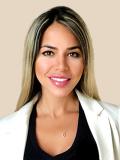
Dr. Gilbert has been working with children, adolescents, and adults for almost ten years and has worked with infants and toddlers as an Infant Toddler Developmental Specialist (ITDS). She graduated from Florida International University with a Bachelor's degree in Psychology and a minor in Behavior Analysis and Masters of Science degree from FIU in Education with a Mental Health Counseling minor. Dr. Gilbert obtained a second Masters of Science in Psychology from CAU. Dr. Gilbert obtained her Doctorate in Clinical Psychology (PSY.D). She is fluent in English and Spanish and understands French.
Dr. Gilbert is deeply passionate about what she does as a professional and looks forward to using her expertise as well as gaining further experience in this field. She has extensive experience conducting behavior assessments and supervising clinicians as well as training parents, teachers and staff. Dr. Gilbert has presented on behavior analysis techniques at workshops, Parent-to-Parent trainings, internationally, UMCARD, various autism awareness events, private/public schools, charity events, and foster homes and shelters in both Spanish and English. Dr. Gilbert has co-authored articles in Parent with Special Needs magazine and has conducted RBT (Registered Behavior Technician) trainings as well as the 40-hour required Behavior Assistant training.
Additionally, Dr. Gilbert is an adjunct professor and teaches Applied Behavior Analysis courses at CAU and is an active member of the southern region Agency for Persons with Disabilities, Local Review Committee where along with the other members provides ongoing technical assistance and consultation as well as approvals for behavior plans presented by other analysts in her region.
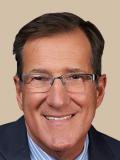
Dr. Ronald Brown, a noted expert on the topic of ADHD has served as the Associate Vice Chancellor for Academic (Health Affairs) at the University of North Texas System.
Dr. Brown completed his Ph.D. from Georgia State University and has been the past President of the Society of Pediatric Psychology and the Association of Psychologists of Academic Health Centers.
He is a board-certified clinical health psychologist and has been an active clinician, teacher, advocate and investigator. He served as a member of the Behavioral Medicine study section of the NIH and chaired several special panels at NIH. He currently serves as the Editor of Professional Psychology: Research and Practice.
Dr. Ronald Brown’s area of specialization includes behavioral sciences, pediatric psychology, attention deficit disorders, neuropsychology, psychopharmacology, learning disabilities and psychosocial oncology.
Jennifer is a dually credentialed professional, licensed and certified as a Speech-Language Pathologist and Behavior Analyst (BCBA). She possesses expertise and advanced skills in teaching language to children on the autism spectrum. She has helped clients across the life span from Early Intervention, Preschool through School in both home and center-based settings. Over the past 10 years, she has successfully integrated strategies and techniques from both disciplines to support individuals with autism and their educational teams.
No reviews yet!
For adding a review for this product you need to purchase current product and be authorized.