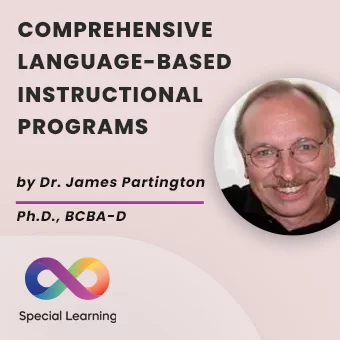
Language-Based Instruction for Children with Autism
For educators and families choosing language-learning priorities, James Partington examines specific skill assessment, the different functions of communication, and teaching across daily routines in this recording, with examples involving meals, laundry, and playground visits.
Presenter biographies: James Partington.
Partington uses assessment grids and a common-object labeling example to show how broad descriptions can miss specific skill gaps. He distinguishes requesting, labeling, vocal imitation, and talking about absent things, even when the spoken word stays the same.
A spontaneous comment about a dog illustrates his concern that repeated follow-up questions can turn communication into work. Daily-routine examples connect parent participation with imitation, listening, requesting, and recounting experiences before, during, and after an activity.
The extended Q&A discusses classroom staffing, prerequisite skills, visual supports, transfer across instructors, reinforcement, and bilingual communication.
What does this recording cover?
- Assessment grids track specific skills and gaps using a common-object labeling example.
- The book example distinguishes requesting, labeling, vocal imitation, and responding about something absent.
- The dog example examines how adult follow-up questions can add demands to spontaneous communication.
- Daily activities provide examples of parent participation and communication practice before, during, and after an experience.
- Q&A topics include visual supports, instructor transfer, reinforcement, and family language.
Recording context: The recording date is unavailable, and Partington states that the session cannot answer every individual child's programming questions.
Three selected learner comments
The six-item evaluation mean was 4.74/5 across 11 complete responses, from 96 recorded rating responses. This mean includes only complete six-score responses. Source: Special Learning's course evaluation records, snapshot October 11, 2026.
Three selected anonymous responses appear below, with the wording and spelling retained. They describe learners' experiences and requests; they are not a guarantee of results or a claim that these comments represent every learner.
This was great - a good review for me.
Course evaluation response, 2023
The course was very helpful and easy. Thanks
Course evaluation response, 2023
Adding subtitles, many peoples have hearing problems
Course evaluation response, 2023
Explore related recorded discussions
MANDATORY DISCLAIMER: The Behavior Analyst Certification Board (“BACB”) does not sponsor, approve, or endorse Special Learning, the materials, information, or sessions identified herein.
Continuing Education Credits
Meet the Presenter

Dr. James Partington is the clinical director of Behavior Analysts, Inc. in Pleasant Hill, California. This psychological corporation provides a variety of educational services for children with autism or other developmental disabilities. Dr. Partington is a licensed psychologist and Board Certified Behavior Analyst with decades of experience. His expertise is in language intervention for children with language delays as a result of autism-related disorders. Dr. Partington received his bachelor’s and master’s degrees from Western Michigan University and his Ph.D. from Florida State University. He has taught courses in the psychology department at West Virginia University, in the education department at St. Mary's College, and in the counseling psychology program at the University of San Francisco. He has published several papers on teaching strategies for children with disabilities, and has co-authored with Dr. Mark L. Sundberg Teaching Language to Children With Autism or Other Developmental Disabilities and The Assessment of Basic Language and Learning Skills (The ABLLS): An Assessment, Curriculum Guide, and Skills Tracking System for Children With Autism or Other Developmental Disabilities.