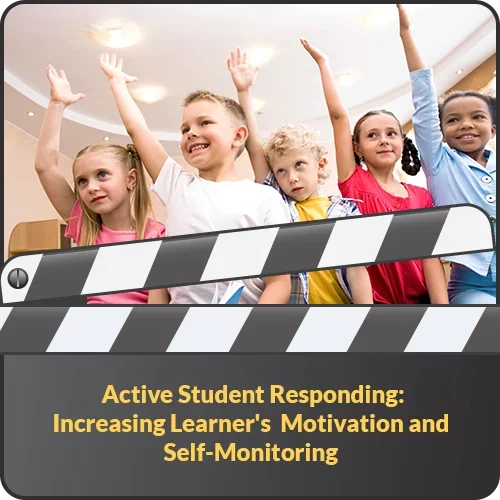
Keeping Students Engaged: Active Student Responding
Michele LaMarche and Miranda Schehr examine how teachers can see every learner's response during group instruction. This recorded session compares choral responding, response cards, guided notes, computer-assisted instruction and peer tutoring, with classroom examples spanning circle time and preparation for returning to public school.
Presenter biographies: Michele LaMarche, Miranda Schehr.
The presenters compare response-card formats, including dry-erase boards and felt boards, and explain why the questions need an unambiguous factual answer. Weather activities and sentence-to-picture matching show how the session applies these formats to group instruction.
The guided-notes discussion follows lecture outlines, main-idea preparation and a color-coded binder example for a student returning to public school. The peer-tutoring section examines alternating learner roles, peer feedback and concerns about anxiety or losing during competition.
What does this recording cover?
- Choral-responding examples use shared cues and short vocal answers.
- The response-card discussion compares answer formats and immediate feedback.
- Guided notes connect lecture outlines with main-idea preparation and study organization.
- Classwide peer tutoring involves role changes, positive feedback and corrective feedback.
Recording context: The historical recording includes a science-lesson video with missing audio, which the presenters narrate live.
Three selected learner comments
The six-item evaluation mean was 4.24/5 across 24 complete responses, from 254 recorded rating responses. This mean includes only complete six-score responses. Source: Special Learning's course evaluation records, snapshot October 11, 2026.
Three selected anonymous responses appear below, with the wording and spelling retained. They describe learners' experiences and requests; they are not a guarantee of results or a claim that these comments represent every learner.
It was great, maybe more video examples of some of the teaching methods of active student responding
Course evaluation response, 2023
I think that it was great training. I really appreciated the video examples, exemplary materials and practical examples.
Course evaluation response, 2023
A lot was just read off slides - prefer something little better prepared or more discussion
Course evaluation response, 2023
Explore related recorded discussions
MANDATORY DISCLAIMER: The Behavior Analyst Certification Board (“BACB”) does not sponsor, approve, or endorse Special Learning, the materials, information, or sessions identified herein.
Continuing Education Credits
Meet the Presenters

Miranda Schehr is the Clinic Transition Director of Step by Step Academy. As a clinic transition director she directs the treatment plans of multiple clients through management, training and supervision of clinical staff. Before her involvement with SBSA she worked as an Intervention Specialist in Applied Behavioral Services, where she was responsible in the implementation of treatment of multiple clients and their families through teaching and training in the classroom and home environments.
She earned her Bachelor of Science in Mild-Moderate Special Education at Xavier University, Cincinnati, OH, completed a graduate coursework in Behavior Analysis in the University of North Texas, Denton TX; and she is anticipating the completion of her Masters of Education in Cognitive and Behavioral Disabilities in August 2012.

Michele LaMarche is the co-founder of Special Learning, Inc. She is also the founder and Executive Director of Step By Step Academy (SBSA), a centre-based non-profit autism treatment centre in Columbus, Ohio. Ms. LaMarche has worked in the field of Applied Behavior Analysis for more than fifteen years, and she develops the ABA curricula used in SBSA's programs.